Controlling GLP-1 Waste with Dietitian-Led Care

Summary
- GLP-1 spend is costly when it doesn’t turn into lasting results, and waste concentrates at three points in the medication journey: starting medication unnecessarily, stopping early, and restarting after weight regain.
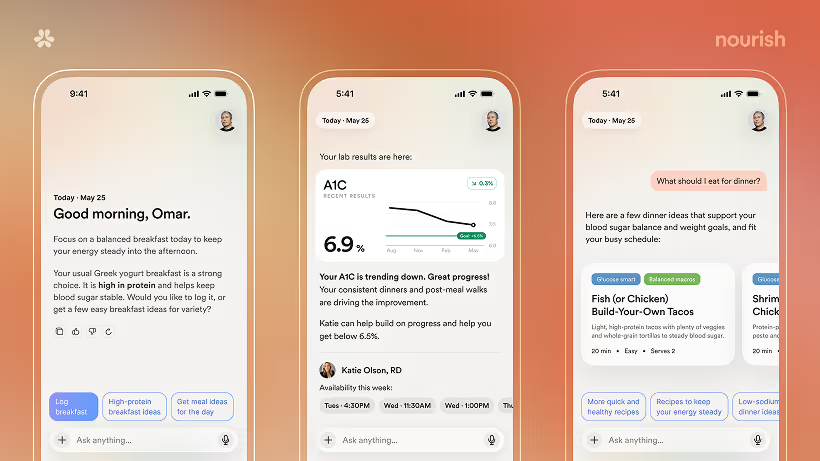
- The Nourish care model puts a registered dietitian at the center of care for all patients regardless of medication status, and provides three distinct pathways for those interested in GLP-1s: nutrition-first, GLP-1 companion, and off-ramp.
- Each of these GLP-1 pathways helps to effectively manage GLP-1 utilization, with estimated waste avoidance of $1,248 for nutrition-first, $360 for GLP-1 companion, and $576 for off-ramp.
GLP-1 medications have changed what’s possible in treating obesity and metabolic disease, but they come with a significant price tag. At an estimated $9,600 per patient per year, stakeholders across the healthcare ecosystem are increasingly concerned about whether that spend turns into lasting results.
A new analysis compares Nourish patient outcomes with published real-world benchmarks to estimate where dietitian-led care plays a role in helping keep that spend from going to waste. Nourish offers three GLP-1 care pathways (nutrition-first, companion, and off-ramp), with each personalized to the health history and goals of patients interested in medication. Each pathway helps to avoid GLP-1 waste through a different mechanism.
Nutrition-first: 10% of Nourish patients are on a GLP-1, compared with 23% of U.S. adults with overweight or obesity; with dietitians as the first touchpoint of care, medication is used only when it’s clinically appropriate. That gap accounts for the largest share of the estimated waste avoidance, at $1,248 per patient.
Companion: Patients on GLP-1s are more likely to discontinue early when side effects and everyday questions go unaddressed. With regular dietitian support and daily tracking between visits, 76% of Nourish patients who start a GLP-1 are still on it at six months, compared with the 61% seen in real-world data. Staying on treatment long enough for it to work is worth an estimated $360 in waste avoidance per patient.
Off-ramp: Coming off of a GLP-1 poses its own risks, including weight regain. With dietitian support through this transition, 64% of Nourish patients maintain weight loss 12 months after discontinuing, compared with 49% in real-world data. Fewer patients losing ground means fewer second courses of medication, and an estimated $576 in waste avoidance per patient.
Much of the value that GLP-1s can deliver is contingent on factors outside of the prescription itself, including who gets one, how long it’s used, and what happens when it ends. A registered dietitian at the center of care ensures medication gets used only when it’s needed, for as long as it’s working, and with a plan for what comes next.
Read the full analysis here.
Frequently Asked Questions
References
View all references
Nourish has strict sourcing policies and prioritizes primary sources, including medical organizations, governmental agencies, academic institutions, and peer-reviewed scientific journals. Learn more about our medical review process and editorial guidelines.
More articles